
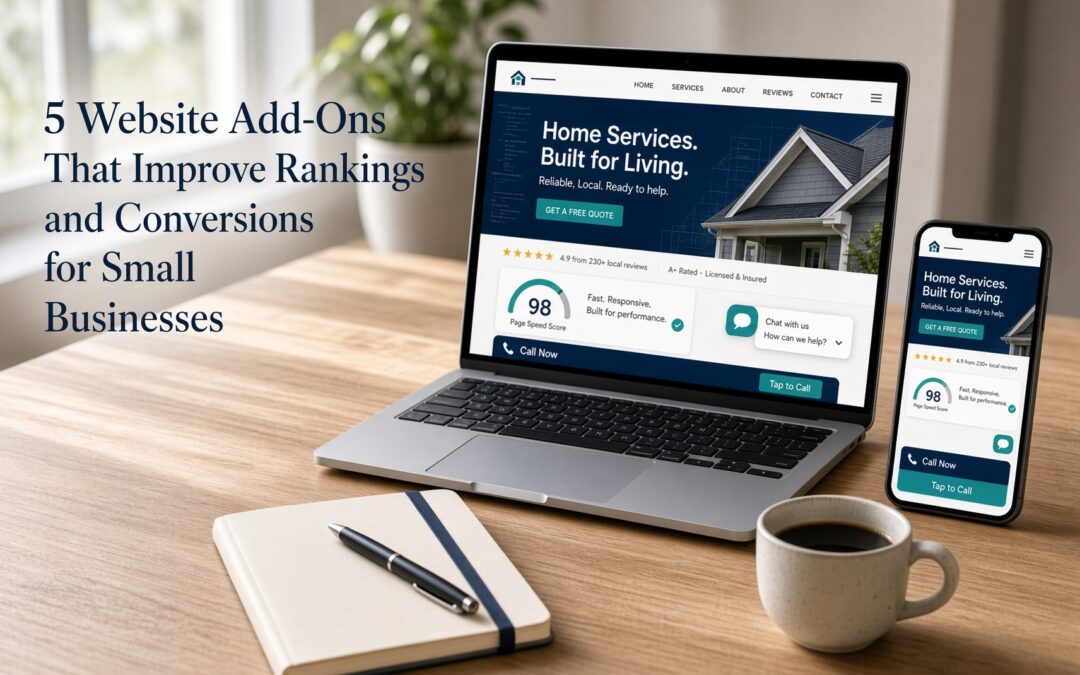
5 Website Add-Ons That Improve Rankings and Conversions for Small Businesses
5 Website Add-Ons That Improve Rankings and Conversions for Small Businesses
A small business website rarely fails because it is missing another page of copy. It fails because visitors cannot tell what you do, cannot tap a phone number on the first screen, wait too long for the page to load, or leave without talking to anyone. Search engines notice the same problems. Slow pages, thin structured data, and a site that never collects proof or leads all make you look like a weaker answer than the competitor down the street.
That is why a handful of add-ons beat a redesign. The right features help Google understand the business, help people act on a phone, and turn existing traffic into calls and bookings. These five are the highest-leverage upgrades most local and service businesses can add without rebuilding the whole site.
Use them in this order if you want the fastest payoff: speed first, then structured data, then mobile contact, then proof, then conversation. For more practical upgrades like this, start with the rest of our free marketing ideas.
1. A speed stack: caching, compressed images, and Core Web Vitals
Speed is both an SEO issue and a conversion issue. Google uses page experience signals, including Core Web Vitals, as part of ranking. Visitors vote faster. A large share of mobile users leave if a page takes more than about three seconds. Each extra second of load time commonly costs several percentage points of conversions. For a plumber, dentist, or HVAC company getting most traffic on phones, that is lost same-day work.
This also pairs with a bigger habit: keeping the website up to date. A fresh site that loads slowly still loses the click.
What a speed stack means in practice:
- Caching so repeat visitors and search crawlers get a pre-built page instead of waiting on the server.
- Image compression and modern formats (WebP or AVIF) so hero photos stop being the heaviest thing on the page.
- A content delivery network if your host is slow or your customers are spread across a region.
- Lazy loading for below-the-fold images and videos.
- Removal of unused plugins, sliders, and chat tools that fire before the first screen even appears.
On WordPress, that usually looks like LiteSpeed Cache or a similar caching plugin, ShortPixel or Smush for images, and a host that is not the cheapest shared plan you can find. On Wix, Squarespace, and Shopify, you get less control, but you can still compress images before upload, avoid autoplay video in the hero, and turn off apps you are not using.
What to change first:
- Compress the homepage hero and every service-page banner.
- Delete or delay scripts that are not needed to render the first screen.
- Test the homepage and your top three money pages in PageSpeed Insights and Search Console’s Core Web Vitals report.
- Fix Largest Contentful Paint first. That is almost always an oversized image or a slow server.
Why this helps rankings: a usable, stable page is easier for Google to crawl and more likely to keep people on the result they clicked. Why this helps conversions: the person searching “emergency plumber near me” will not wait for a 4 MB slider. They will tap the next listing.
Common mistake: installing five performance plugins and a heavy page builder, then wondering why the site got slower. One caching tool, one image tool, and fewer moving parts beat a pile of “optimization” add-ons. If you want a punch list of what is slowing your site down, run a free website audit.
2. Structured data that tells search engines and AI tools who you are
Schema markup is code that labels your business the way a business card labels a person. Name, address, phone, hours, service area, services, and frequently asked questions stop being a guess and become structured facts. It is one of the cheapest technical upgrades a small business can make, and it supports the same local visibility work covered in our local SEO tips for small businesses.
The types that matter most for a local or service business:
- LocalBusiness or the closest specific type (
Dentist,Plumber,HVACBusiness,Restaurant). Serviceon the pages that actually sell the work.FAQPageon pages that already answer real customer questions.BreadcrumbListso search engines understand site structure.
What schema does well: it helps Google attach the right entity to the right listing, supports richer results when Google still shows them, and gives AI search tools cleaner facts to cite. What it does not do: guarantee a #1 ranking by itself. Treat it as clarity, not a ranking hack. Google’s own documentation for LocalBusiness on Schema.org is the clean reference for required fields.
Two rules that keep you out of trouble:
- Mark up only what is visible on the page.
- Do not add self-serving review stars to your own
LocalBusinessmarkup. Google already pulls ratings from Google Business Profile. Fake or recycled review schema is a common way local sites get ignored or penalized. Follow Google’s review snippet guidelines.
How a small business can add it without a developer:
- WordPress: Yoast SEO or Rank Math can output LocalBusiness and FAQ markup from settings and on-page blocks.
- Other builders: look for an SEO or schema app, or add JSON-LD in the header through the site’s custom-code box.
- Validate with Google’s Rich Results Test and the Schema Markup Validator.
- Keep NAP data identical to Google Business Profile and the footer of the site.
Example: a residential HVAC company adds LocalBusiness markup on the homepage and Service plus FAQ markup on “AC repair,” “furnace replacement,” and “same-day service.” The visible FAQ answers “Do you service my ZIP code?”, “Are you licensed?”, and “What should I do if the unit is frozen?” Search engines stop guessing. AI answers get less generic. Click-through improves because the result looks like a real business instead of a thin brochure.
3. A mobile contact bar with click-to-call and click-to-text
Most small-business websites still hide the phone number in the header and ask mobile visitors to fill out a five-field form. That is the wrong default. For home services and many local professionals, a phone call is the conversion. Phone leads convert on the call at a much higher rate than form fills. A large share of those calls start on a phone.
The add-on is simple: a sticky bar or floating buttons that stay on screen as the visitor scrolls. This is one of the fastest design upgrades you can make, and it works with the same usability thinking in our guide to better web page design.
What the bar should include:
- A tap-to-call button using a
tel:link and the same number you list everywhere else. - A tap-to-text button using an
sms:link if your team actually answers texts. - Optionally a “Book now” button if you take appointments.
- Enough contrast and tap size that a thumb can hit it on the first try. Apple’s button guidance is a useful minimum: make the tap target large enough to hit without zooming.
Placement matters more than design. Put the number in the first screen on mobile, keep it sticky, and repeat it near the end of every service page. “Call now” outperforms “Contact us.” Hierarchical options work well: phone first, text or chat second, form last.
Track it. A click-to-call button you cannot measure is a decoration. Use Google Analytics events, Google Ads call reporting if you run ads, or a call-tracking number that still matches your branded number in local listings when possible. Do not create a NAP mismatch just to get fancy tracking.
Why this helps rankings only indirectly: people who can act stay longer and bounce less. Why this helps conversions immediately: the visitor already decided they need a roofer. Your job is to remove the extra taps between that decision and your phone.
Example: a dental office moves the phone number from a tiny header link into a sticky “Call to book” bar and adds text-to-schedule after hours. Same traffic. More booked exams, because the site finally behaves like a business that wants the appointment.
4. On-site proof: reviews, photos of real work, and trust signals
People do not convert because a headline says “trusted since 1998.” They convert when they see evidence. Reviews, project photos, licenses, and specific outcomes reduce risk. They also give you content search engines can associate with the business. Reputation work off the site still matters; see our notes on reputation management if the public review profile is the weak link.
The useful add-ons here are not another testimonial slider that auto-rotates too fast. They are:
- A Google reviews feed or a curated set of first-party testimonials on the homepage and every service page.
- Star ratings next to the service you actually sold, with the reviewer’s first name and town when you have permission.
- Before-and-after photos or job photos with short captions (“Furnace replacement in Towson, 2026”).
- License, insurance, and association badges that are real and current.
- A short “what happens after you call” block so the next step feels safe.
This supports local SEO when the same proof appears consistently on the website and on Google Business Profile. Fresh photos and new reviews are also proof of life. A site that still shows three quotes from 2019 looks abandoned even if the company is busy. Google’s own help center on responding to reviews is worth following while you collect new ones.
Do this the right way:
- Collect reviews on Google first. That is where local pack trust is built.
- Display a sample on the site. Do not scrape reviews into schema in a way that violates Google’s guidelines.
- Put proof next to the call button, not in a distant “Testimonials” page nobody opens.
- Update monthly. One new review and one new job photo beats a giant archive you never touch.
Example: a landscaper adds a “Recent work” row with five jobs, each tied to a suburb they want to rank in, plus three short reviews that mention drainage, patio install, and spring cleanup. The page starts answering “Can they do this in my neighborhood?” instead of only “Do they have a website?”
If you want a snapshot of how your review profile looks today, run Heitz Digital’s free online review scan.
5. A conversation layer: chat, after-hours capture, and booking
The last gap is what happens when someone is ready but not ready to call. Live chat, an after-hours assistant, and a booking widget turn anonymous visits into conversations. Used poorly, they annoy people and slow the site. Used well, they catch the visitor who would have closed the tab.
What actually converts:
- A chat widget that answers common questions in the first minute: pricing range, service area, same-day availability, and whether you work with a customer’s insurance or equipment brand.
- Human handoff during business hours. A bot that cannot pass the conversation to a person becomes a dead end.
- After-hours capture that takes a name, issue, and number, then texts the owner.
- An appointment scheduler for businesses that run on bookings: dentists, salons, consultants, clinics, tutors.
- Short forms as a backup, not the only door. Name, phone, one question. Long forms leak leads.
Free or low-cost starting points include HubSpot’s free live chat tools, Tidio, a native builder booking app, Calendly, and Google’s own booking links when they fit the industry. Install one conversation tool, not three.
Rules that keep this from hurting rankings:
- Load the widget after the main content so it does not wreck Core Web Vitals.
- Do not fire a popup on the first second of a mobile visit.
- Use proactive chat only on high-intent pages (“AC repair,” “emergency plumber,” “book a cleaning”), and wait until the visitor has scrolled or spent a little time.
- Route messages to a phone that someone checks. An unanswered chat is worse than no chat.
Why this helps conversions: visitors who engage with chat convert at a much higher rate than visitors who never get a question answered. Why this can help rankings: more engaged sessions and more completed actions are healthier site signals than a bounce from a silent brochure. Pair this with the technical basics in these SEO tips so the extra conversations come from people who already searched with intent.
Example: a med spa keeps click-to-call for people ready to book and adds a widget that answers “What’s the downtime?” and “Do you take new clients this week?” After hours, the bot collects a number. Morning staff call back before the prospect books the competitor who answered first.
What to add first: a 30-day plan
You do not need all five this week. You need the ones that remove the biggest leak.
Days 1–7: Speed and measurement
Run PageSpeed Insights and a free website audit. Compress images on the homepage and top service pages. Turn on caching. Confirm Google Analytics and Search Console are installed.
Days 8–14: Make the site callable
Add the sticky call / text bar. Put the number in the first screen on mobile. Set up basic call or click tracking. Shorten the contact form.
Days 15–21: Explain the business to machines
Add LocalBusiness schema and Service/FAQ markup on money pages. Match name, address, phone, and hours to Google Business Profile. Test the markup with the Rich Results Test.
Days 22–26: Put proof where decisions happen
Add reviews and job photos to the homepage and two service pages. Remove vague stock photography if you have real work to show. Scan the public profile with the online review audit.
Days 27–30: Open a conversation
Add one chat or booking tool on high-intent pages only. Write five canned answers. Decide who replies, including after hours.
Then leave the features alone long enough to measure. Watch calls, form submits, booked appointments, and Search Console clicks. Keep the add-on that produces contacts. Remove the one that only adds weight.
Mistakes that waste the upgrade
- Installing every plugin in a “best of” list. Each one has a cost in speed and maintenance.
- Chasing review stars in schema instead of earning reviews on Google.
- Hiding the phone number because the site “looks cleaner.”
- Using a chatbot as a replacement for a business that never answers the phone.
- Updating the website and ignoring Google Business Profile. Local results still compare the two.
- Measuring traffic and never measuring calls.
A small business does not win by having the most features. It wins by making the next step obvious and making the business easy to identify in search.
Keep the features, then keep the site useful
These five add-ons work because they fix the two jobs a small-business website actually has: get chosen in search, then get contacted. Speed and schema help you get chosen. Click-to-call, proof, and conversation help you get the job.
If the site is already live, start with the sticky call bar and image compression. Those two changes are visible this afternoon. Schema and reviews compound over the next month. Chat only pays off if someone on your team will answer.
For more practical upgrades, browse the rest of the free marketing ideas. If you want the gaps on your own site spelled out, use the free website audit and online review scan. If you would rather have it implemented as a system instead of a weekend project, hire the agency or learn more about Heitz Digital.
Recent Comments